
Ever realize why your face looks weird in a selfie but normal in a mirror? That’s symmetry, or the lack of it. A human face has a vertical axis of symmetry right down your nose. But if you’re like me, your left eyebrow is slightly higher than your right. That’s your face telling you it’s not a perfect parabola. And that’s okay—math doesn’t judge your sleep schedule.
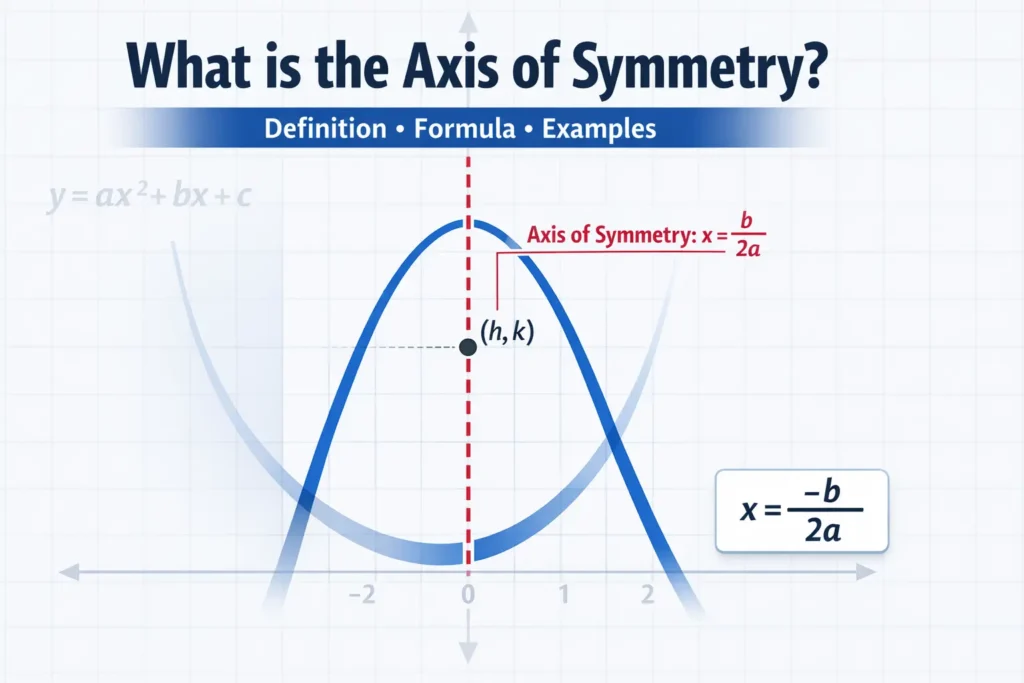
When you find the axis of symmetry in a graph, you’re basically looking for the center line of a parabola. Imagine a roller coaster track that goes up, then curves down into a dip. The axis is the spine of that curve—the line right through the middle where if you folded the coaster, the two sides would line up. It’s the quiet, boring line that makes the whole ride symmetrical.
The Boring Math Trick (That Actually Works)
Here’s the part where your math teacher tells you a formula, but I’ll say it like a lazy Sunday morning. For any quadratic equation like y = ax² + bx + c, the axis of symmetry lives at x = -b / (2a). Yes, it’s that simple. It’s like discovering the secret password to a clubhouse. Once you know -b over 2a, you can find that line faster than you can find the remote under the couch cushions.
Let’s say you’re dealing with y = 2x² + 4x + 1. Your a is 2, your b is 4. Plug it in: x = -4 / (2 * 2). That’s -4 / 4, which equals -1. So the axis of symmetry is at x = -1. See? No crying, no calculator throwing. Just pure, cold symmetry.
 What Is The Axis Of Symmetry? Definition And Examples

